Hindu-German Conspiracy Trial – Harcharan Das Court Testimony
Trial Log
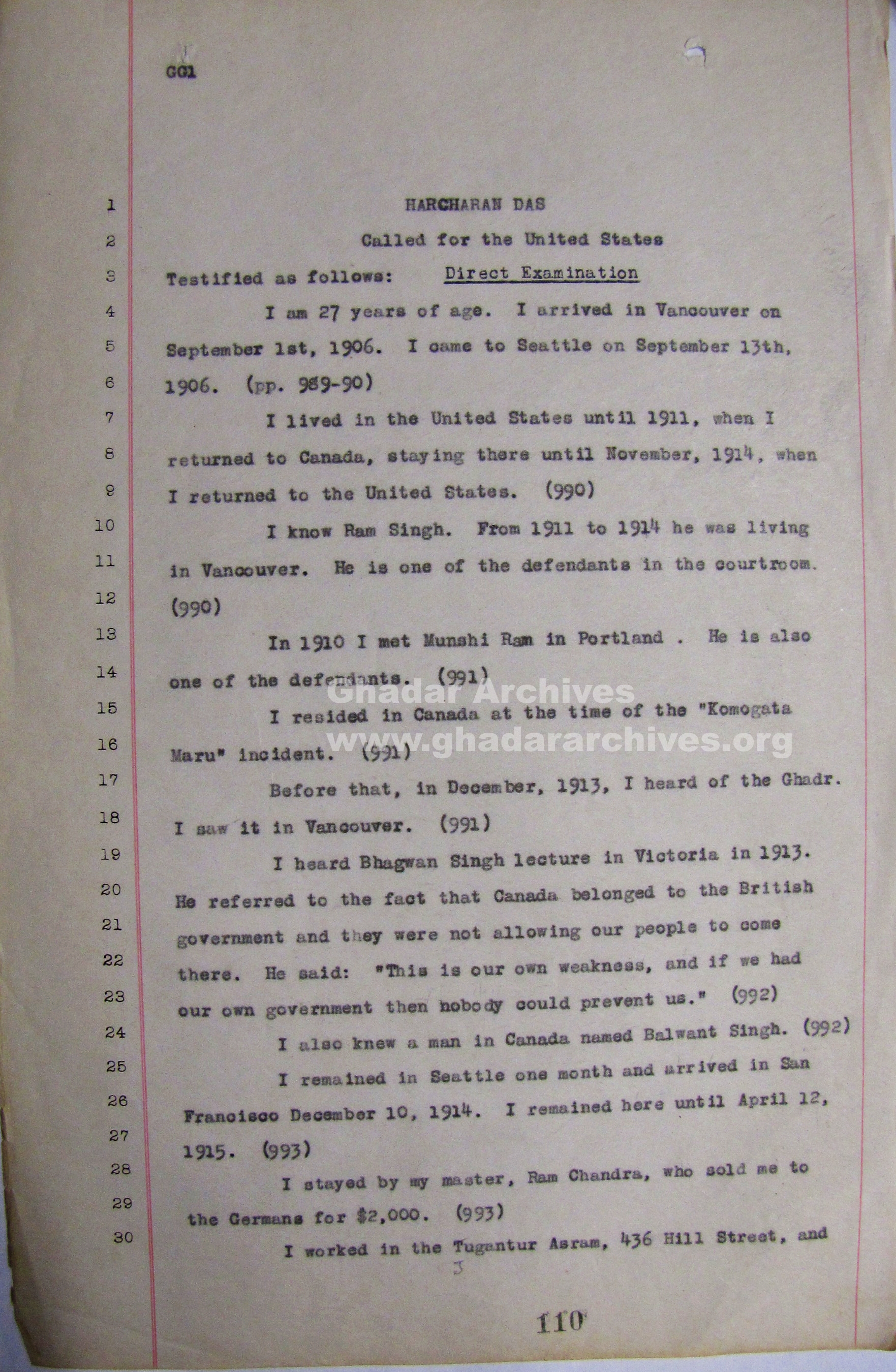
Image 1 (2 images)
Transcription
Harcharan Das
United States v. Hindu-German Conspiracy Trial – Court Testimony
Testified as follows: Direct Examination & Cross-Examination
Transcription of court testimony. Page numbers and transcript volume references (pp.) from the original dataset are preserved.
Direct Examination
001 — Transcript pp. 909–993
- HARCHARAN DAS
- Called for the United States
- Testified as follows: Direct Examination
- I am 27 years of age. I arrived in Vancouver on
- September 1st, 1906. I came to Seattle on September 13th,
- 1906. (pp. 909-910)
- I lived in the United States until 1911 when I
- returned to Canada, staying there until November, 1911, when
- I returned to the United States. (990)
- I know Ram Singh. From 1911 to 1914 he was living
- in Vancouver. He is one of the defendants in the courtroom.
- (990)
- In 1910 I met Munshi Ran in Portland. He is also
- one of the defendants. (991)
- I resided in Canada at the time of the "Komogata
- Maru" incident. (991)
- Before that, in December, 1913, I heard of the Ghadr.
- I saw it in Vancouver. (991)
- I heard Bhagwan Singh lecture in Victoria in 1913.
- He referred to the fact that Canada belonged to the British
- government and they were not allowing our people to come
- there. He said: "This is our own weakness, and if we had
- our own government then nobody could prevent us." (992)
- I also knew a man in Canada named Balwant Singh. (992)
- I remained in Seattle one month and arrived in San
- Francisco December 10, 1914. I remained here until April 12,
- 1915. (993)
- I stayed by my master, Ram Chandra, who sold me to
- the Germans for $2,000. (993)
- I worked in the Yugantar Asram, 436 Hill Street, and
002 — Transcript pp. 993–998
- at 1234 Valencia Street in the printing office. (993)
- I was employed at the Yugantar Asram by Ram Chandra.
- I lived there and worked on the paper. I got my board, my
- bed and $2 a month. (994)
- The following worked on the paper: Ram Chandra; he
- was the master; Godha Ram was his secretary and wrote articles
- against the British government; (994) Gobind Bahari Lal was
- special correspondent and also wrote articles; Sundar Singh
- was working on the printing press with me. (995)
- Sundar Singh and Munshi Ram were honest. (995)
- Gopal Singh was the Gurmukhi copy writer. (996)
- Khem Chand and Mangu Ram also worked there. (996)
- The paper was published only in Urdu and Gurmukhi,
- but Ram Chandra wrote the headlines in ten or twelve different
- languages; he was just telling lies. (996)
- I don't like Ram Chandra very well. When he put us
- in trouble for nothing and sold me, then he can't expect any
- thing better. (996)
- They published the Fatwa in one of the papers, half
- in Urdu and half in Pashtu, for those from Turkey and between
- Afghanistan and India. (997) The Fatwa was the decree for a
- holy war. (997)
- Each week there was published in Urdu sometimes 1800
- to 2000 copies; in Gurmukhi 2200 to 2400 copies; to outside
- people sometimes went 5,000 or 10,000 copies. They were sent
- through the mails. (997)
- They had two registers containing names of persons to
- whom the papers were to be sent, one for this country and Canada
- and one for foreign countries. (998)
- When I met Ram Chandra he questioned me about where I
003 — Transcript pp. 999–1003
- come from and how they allowed me to come to this country, and
- then told me to go to the printing office and see the artilleries
- working making shells for the English - that is, out of ink. (999)
- After being there for two days Munshi Ram, Mangu Ram
- and Sundar Singh told me that Ram Chandra said that I was a
- detective, and not to keep me any more, but they persisted
- and allowed me to stay. Ram Chandra did not like me, thinking
- I was a detective. (999)
- A couple of days later Ram Chandra told me I could
- stay. My work was to help on the printing press with Mangu Ram
- and Sundar Singh. (1000)
- Godha Ram was secretary; he copied articles in Urdu
- and did lithographic work and proof-reading. These articles
- were composed by Ram Chandra, Gobind Bahari Lal and other people,
- who sent them by mail. (1001)
- Gopal Singh stayed only a month. He was Gurmukhi
- proof reader, and brought the mail from the post office. (1001)
- Ram Chandra had two post boxes here, but had other
- boxes in Seattle, Stockton, Sacramento and other places. (1001)
- He had many names. I only knew him by Ram Chandra and
- "Hindu Student." (1001)
- Godha Ram, Ram Chandra and Gobind Bahari Lal opened
- the mail. I was not permitted to see it. Munshi Ram formerly
- assisted in opening the mail, but went away two or three weeks
- after I came, having had a quarrel with Ram Chandra. (1002-3)
- The address books were kept at night in the Bank of
- Italy. These registers would be taken to the bank vault, first
- by Munshi Ram and after he left by Karajan Das. He also went
- after them in the morning. (1003)
- Ram Chandra told me that Har Dyal was the founder of
004 — Transcript pp. 1004–1006
- the paper; that he was arrested and turned its charge over to
- Bhagwan Singh, Barkatullah and Ram Chandra. (1004)
- When I came to work, neither Barkatullah nor Bhagwan
- Singh were in the city. Chandra told me that Bhagwan Singh
- had gone to Manila and Barkatullah to Turkey. (1004) He said
- that Barkatullah would first go to Turkey, then to Persia, and
- then to Afghanistan, to tell them in the latter place to join
- the holy war against the British. Barkatullah is a Mohamedan. (1004)
- Ram Chandra told me Bhagwan Singh had gone to Manila
- to collect money and incite the people to go to India for the
- revolution. He was to send the money to Ram Chandra. (1004-5)
- I saw the defendant Ram Singh at the printing office
- and at the Asram. Ram Chandra told me he sent him to India
- and had paid for his passage and expenses. (1005)
- I never saw Santokh Singh, but was told by Ram Chandra
- that he was sent to Siam as agent for the Ghadar party, to help
- the people who afterwards went from this country to cross the
- boundary to Burma or India. (1005-6)
- Ram Chandra showed me rules for the government of the
- Asram and the Ghadar. They were in writing. The substance of
- them was as follows:
- (a) A man cannot become a member of the Ghadar Party
- unless recommended by one or two men from the staff.
- (b) If anybody worked less than six months in the
- Asram he is not entitled to be told all of its secrets.
- (c) If anybody exposed these secrets or grafted money,
- he must be killed.
- (d) Both sexes can become members of the Ghadar Party.
- The marriages were to be free, that is, not to be allowed by
005 — Transcript pp. 1007–1013
- priests or any authority.
- (e) The managing committee, the secretary and the
- president could go outside and plead to the people the cause
- and collect money for the Asram.
- (f) Only the secretary and Ram Chandra should see the
- mail.
- There were seventeen in all, but I don't recall the
- others. (1007-9)
- Traveling presidents and secretaries to collect moneys
- in various places were appointed. Sohan Singh was traveling
- president for California, Washington and Oregon. (1009)
- The moneys were sent to Ram Chandra. There were two
- separate funds kept, one covering the expenses of the Asram
- and newspaper, for which monthly reports would be sent out;
- No one could see this account except Ram Chandra and
- the secretary, Godha Ram. (1010)
- Mangu Ram told me that they had 140,000 in the fund. (1011)
- Ram Chandra told me that Bhagwan Singh collected $1700
- at Manila which he did not send him; that he received a letter
- stating that he was spending it on himself. He then received a
- letter from Bhagwan Singh stating that he had collected the
- money and was spending it on the Ghadar cause in Manila. (1012)
- The name of the man who wrote the letter about Bhagwan Singh
- was either Mukand Lal or Mukand Singh. (1013)
- When Ram Chandra was discussing this matter Sundar
- Singh, Godha Ram, Gopal Singh, Gobind Bahari Lal and myself
- were present. (1013)
- Ram Chandra sent five or six men to Germany. They
006 — Transcript pp. 1013–1019
- Shiv Div Singh, Kidar Nath Sondi, Anim Chand Sharma and Kartar Ram.
- Ram Chandra had bought a ticket for Mangu Ram, but they
- didn't want him to go. (1013-14)
- Mangu Ram told me that the others were Brahmans and
- educated, and didn't want to take him, who was not. (1014)
- Ram Chandra told me that the Canadian Hindus did
- nothing for the "Komogata Maru"; that he had sent two men to
- give them revolvers and scatter literature at Yokohama on their
- return trip. (1015)
- Ram Chandra also said: "I am shipping literature, arms
- and ammunition to India, and goods in the care of American mer-
- chants."
- He said they were packed with machinery, iron and
- things. They were buying so many thousand dollars worth
- of machinery and some arms and putting them together. (1015)
- Gobind Bahari Lal left before I did. I asked where he
- went, but they didn't tell me. (1016)
- "Received two hundred and eighty dollars from
- Ram Chandra, September 17, 1915.
- (Signed) G. B. Lal." (1016)
- Mr. Royce: Our claim is that Mr. Lal borrowed that
- money and used it on his trip to England, which is legitimate.
- It was a mere loan. (1016)
- Gobind Bahari Lal wrote one article that I know of,
- published in the Ghadar. It was after a conference he had with
- Dr. Franck, a German socialist. The article was about how the
- Germans treated Indian prisoners in Germany, giving them better
- food, etc. than the British, French or Russian. (1017)
- It appeared in the Ghadar in January or February, 1915.
- He also wrote an article on the financial condition of India. (1019)
007 — Transcript pp. 1019–1021
- They published 5,000 circulars containing the statement:
- "Don't fight with the Germans, they are our friends; the British
- are our enemies. Lay down your arms and run to the Germans and
- fight against the British." (1019)
- Ram Chandra said: "I will send these to Germany and by
- the aeroplane we will throw them to the Indian forces in France."
- (1019-20)
- These circulars were taken away one night by a German
- officer from San Francisco (identifies von Brincken as the man)
- (1020-1)
- The next day I asked Ram Chandra if the papers were all
- gone and he said "Yes, the officer came last night. He was from
- the German consul and he took all the papers to send them to
- Germany. (1020)
- Funds were coming from the laborers outside. One day
- a machine broke and I told Ram Chandra we needed some money to
- buy a new machine. Sundar Singh also said that. Ram Chandra
- said: "We don't need to beg our countrymen, these laborers,
- because I have a good treasurer and I can get as much money
- as I want, from the Germans; they are supplying all the money
- we need nowadays. (1021)
- Ram Chandra communicated with the German Consul at San
- Francisco. They were always speaking on the phone and he told
- me many times: "I am going to see the German consul." (1021)
- I wanted to go back to India and Ram Chandra told me
- to wait a few days and he would send me somewhere. In a day or
- two he said: "One of my friends' steamers is going to Java or
- Borneo, and if you want to go on that steamer you will save your
- expenses and will also get some money. I said all right. I
- asked how many more men were to be sent and he said: "Yourself,
008 — Transcript pp. 1021–1065
- Mangu Ram, Gambhir Singh, Hari Singh and Harnam Chand. (1022)
- He did not tell me that the steamer belonged to the
- Germans or was carrying ammunition to India. (1022)
- He also told me that I could go to Java on the steamer,
- and that India had passed a law permitting the internment of
- any immigrant, and if I didn't want to stay over there I could
- come back on the same steamer from Java or Borneo. (1022-1/2)
- Upon one occasion I went to Fresno with Ram Chandra and
- Godha Ram, to attend a meeting to collect money and deliver
- speeches. Ram Chandra and Godha Ram spoke. I delivered a
- couplet which contained the statement: "How long will you keep
- on drinking the cup." (1062)
- My couplet was against the British government, telling
- people to wake up and go to India, and fight with the Indians.
- against the British. (1063)
- Godha Ram said: "Give your money to the Ghadar Asram
- and go to India; this is a great chance for us." (1063)
- Ram Chandra started to cry, and said: "Give all your money
- to me and the Asram, and go to India and fight." (1063)
- About 500 people were present, from whom they collected
- $800. (1063)
- At that meeting there was Gurdas Ram, who made a speech.
- (1064)
- I know Nawab Khan in Canada. Before I came here he had
- left for India. (1065)
- Ram Chandra told me he had sent several thousand men
- to India. (1065)
- Ram Chandra told me that Rikki Kesh was the first Hindu
- that went to Germany from the United States; that he went as
- soon as the war started. (1065)
009 — Transcript pp. 1065–1068
- Five Hindus went on the "Maverick." Gambhir Singh
- was writing in the place of Godha Singh, who was sick. He came
- from Fair Oaks, near Sacramento. Hari Singh came from Brawley,
- Imperial County, Southern California, Mangu Ram from Fair
- Oaks, and Harnam Chand came from Los Angeles. (1065)
- The five of us left San Francisco April 12, 1915. At
- ten o'clock the night before we were told by Ram Chandra to
- pack up. He took us to Mission Street, then said, "It
- is too late to catch a train now, and that he would meet us
- in the morning. He left us at a hotel on Mission Street between
- 18th and 20th Streets. He went home. (1065)
- At that time I had about $350. (1065)
- The next morning we met Ram Chandra, who bought five
- tickets and we went to Los Angeles from Third and Townsend
- Streets. Ram Chandra brought five suitcases with him and
- gave them to us. They were full of Ghadar literature. These
- suitcases were in addition to those we had. (1066)
- We arrived at Los Angeles about 12 at night, and as
- we got off the train we met a young man who had spectacles on
- and a white flower on his coat. He asked who Hari Singh was
- and then took him into the waiting room. When he returned,
- Hari Singh told us: "He is one of the officers of the steamer
- on which we are going to leave this country." (1067)
- Before leaving, Ram Chandra told us that Hari Singh
- had the program, and that we were to follow him. (1068)
- I never saw that white man after that night. Hari
- Singh said he was to recognize this man by the flower that he
- wore. This man took us to a hotel and went away. (1065)
- The next day a stout fellow, not very tall, medium
- size, asked for Hari Singh and shook hands with him and took him
010 — Transcript pp. 1069–1071
- to his room, where they talked for about two hours. Hari Singh
- told us that he was the captain of the steamer. His name was
- Mueller. He was the captain of a German schooner interned here
- in Oakland. (1069)
- We stayed eight or nine days in the hotel. Hari Singh
- was busy on the telephone all the time. Mueller came every day
- to see him. Hari Singh told us the steamer was not ready.
- Afterwards I got to know that the steamer had gone into drydock
- for repairing. (1069)
- About seven o'clock on the evening of April 21st Mueller
- and Starr-Hunt came to the hotel and took us to San Pedro or
- Long Beach. Then they went to get a boat to take us to the
- "Maverick." She was about a mile off the dock. They put us
- in a hotel again and the next morning they came back and took
- us to the steamer. (1069-70)
- When we arrived on the dock the next morning a steamer
- came from San Francisco, from which they landed the waiters, a
- cook and six firemen and oilers, and we all went in the small
- boat to the "Maverick." (1070)
- About three o'clock the harbor master came and took
- all the names, and he took down our names as waiters. Starr-
- Hunt, Mueller and Hari Singh told us to do that. We were
- to get $30 a month.
- We adopted Mohammedan names of Persian nationality.
- Ram Chandra had arranged the names. They are as follow:
- Hari Singh was Jameshed Jahangir;
- Gambhir Singh was Shamsher;
- Mangu Ram was Nizam Din;
- Harnam Chand was Hattum Dutt
- I was Rustum Khan. (1071)
- Hari Singh showed me $600 in travelers' checks, but I believe he had more. (1071)
011 — Transcript pp. 1071–1074
- The "Maverick" had three tanks, two full of oil and
- one empty. She had no other cargo. She had no picks or shovels.
- (1071)
- We left our baggage at the railway station. We gave
- our checks to the white man and found our trunks on the steamer.
- (1072)
- That man (referring to Bley) I saw at Los Angeles, at
- Long Beach no, at San Pedro. He came on board the "Maverick"
- about the time she sailed. There were five or six men with
- him. Starr-Hunt and Mueller were there. (1072)
- I don't recognize Mr. Sauerbeck. (1072)
- Mueller was on board the vessel as a passenger. Nelson
- was captain and Starr-Hunt purser. (1072)
- We signed for six months. (1073) We were told that
- the vessel was bound for Borneo. We were told that by the
- officer that took our names, and before that by Ram Chandra, Hari
- Singh, Starr-Hunt and Mueller; everyone said that. (1073)
- I saw Mr. Bley, the gentleman that stood up, on April
- 22nd, 1915, before sailing. (1073)
- After four or five days we stopped at a place called
- San Jose del Cabo. Starr-Hunt, Mueller and Capt. Nelson used
- the gasoline launch and went ashore. Mueller never returned.
- (1073)
- We heard that Mueller and some of the sailors on the
- "Maverick" had been on a German schooner interned in Oakland,
- that had run between San Francisco and Marshall Islands. (1074)
- The sailors from the schooner were Marshall Islanders,
- and were told that if they wanted to go back home they could
- do so on this steamer. (1074) The Marshall Islanders came
- on the ship from San Francisco that discharged some men the
012 — Transcript pp. 1074–1077
- day we sailed. (1074)
- We left San Jose del Cabo the next day and landed
- at Socorro Island. They blew ten or twelve whistles. Two
- white men came on the steamer, and the next morning they
- went back and brought two more. There were four men living
- on the island. They were with the schooner that was appointed
- to meet the "Maverick" at that island. (1075)
- The sailor said: "We had schooner here which has
- 6,000,000 cartridges and about 60,000 or more rifles and
- pistols and machine guns. It is full of ammunition and arms,
- and we are waiting for you fellows here. The "Maverick"
- could not come on time, and they had finished their water
- and food stuffs, and went back, leaving those four men there
- to tell the "Maverick's" officers." (1075)
- We stayed there about a month. Hari Singh and Starr-
- Hunt going every day to the mountains with the telescope watch-
- ing for a schooner or steamer, but none came. (1075)
- The men who were living there had steam pipes, with
- which they were making sweet water out of ocean water. (1076)
- After two months a United States man of war came and
- took the four men away, the four men that had been left there
- by the schooner. (1077)
- After few days later the "Ghant," a British man of war,
- came, which searched our ship. Later the "Rainbow," a British
- man of war, came and did the same. (1077)
- When the first man of war came we forced Starr-Hunt
- and Hari Singh to burn up the papers in those grips, which
- was done. (1077)
- Upon leaving Socorro Island, Starr-Hunt and Hari
- Singh wanted to leave me, Gambhir Singh and Harnam Chand on
013 — Transcript pp. 1071–1079
- the island. We refused to stay. (1078)
- Q. What did Starr-Hunt want you to stay on the island
- for, did he tell you?
- A. For the same purpose that the other sailors were there.
- THE COURT: Q. To wait for the schooner?
- A. Yes, sir. (1078)
- I think the schooner's name was "S. Henry," or some-
- thing like that, or "Larsen." (1078)
- Before leaving the island some writing was left behind.
- (1078-1/2)
- I saw the Ghadar literature before it was burned at
- Socorro Island. The title of one piece was Nim Hakim Khatrajan,
- which means "Undergraduate doctor is dangerous for life;"
- also Ghadar di Gung; also some Ghadar di Gunj newspapers; also
- British Rule in India, by Bryan, and a Fatwa, which is a decree
- proclaiming holy war on behalf of the Mohammedans. (1079)
- This literature was burned after the two war vessels
- had already searched the "Maverick"; the third had not come
- yet and then we had to go in the fire room.
- Mr. Preston offers in evidence page 16, poem 17 of
- the Song Book.
- MR. ROCHE: I want to save the point that we have
- maintained during the entire trial. I object to it as immaterial,
- irrelevant and incompetent, and that no literature of that kind,
- or anything of the kind, can by any possibility tend to establish
- a conspiracy to set on foot a military enterprise or expedition.
- THE COURT: The objection is overruled.
- MR. ROCHE: Exception.
014
- "Oh! Sons of Father (India)
- Sit in the Council of resolve
- Pay careful heed to these,
- The proud-spirited ones of Ind.;
- We appear as if we are sinking.
- So search for a way and means.
- Oh! simple-minded brethren,
- Full of spirit of resolve,
- You will find this resolution,
- To be a panacea for all.
- Let your pride in your nativity,
- Be the salvation of India's name.
- Rage, which destroys the body,
- You must use in some fruitful way.
- As you did in 1857.
- Be careful! and do not waiver,
- But strengthen your uncultured minds,
- Balance, therefore, your simple minds,
- A prey to conflicting passions,
- Be careful! when chance doth offer.
- That your mind do not betray you,
- But test your fickle will;
- Test your mind as you would test china,
- By rapping to discover flaws.
- For long ages have you spoken,
- Using the term, 'Your Excellency,' 'Your Excellency'
- Change then your coward spirit,
- And give it a lion's strength.
- Let us not ascend in such manner,
- As to collapse most suddenly and fall,
- But do your work by numbers,
- First learn to master the alphabet,
- And after that to spell.
- To accustom your vision to the sight of the sword
- You must first become used to a dagger,
- To prevent mental perturbation.
- Perhaps guns and cannon might frighten you,
- So practice first with the revolver.
- Let it not be that while you sleep,
- The enemy come and destroy you,
- So throw off the mantle of lethargy.
- Now cast about your neck.
- Let it not be when chance will offer,
- That your mind suggest some other course,
- And so remorse befall you.
- The result of a fickle mind,
- To prevent a party disunion,
- Love must reign among us.
- Let it not be that you shall listen
- And be drawn to the enemy side,
- Nor by doing so you bring ruin,
- On your party and yourself.
- Don't blink your eyes like a pigeon,
- But flee at the cat's approach.
- Strike on the nose the canine,
- Which perchance may cross your path,
- And act not like the rooster,
- Which perchance may its limbs,
- And gazing on all four sides,
- Falls a victim to the dog.
015 — Transcript pp. 1082–1085
- Let it not be when chance shall offer,
- That your mind shall prompt forgiveness,
- But steal your fickle mind.
- Drop the garments of a mendicant,
- And invoke the spirit of a lion,
- And possess yourself of the brains
- Necessary for the conduct of national affairs.
- To me is come a remembrance
- Of a cure for those 'possessed',
- Which, allow me to show to you.
- Pay careful attention to this first duty,
- Which is as I shall explain.
- First place the dung on the fire,
- So as to cause the gas to rise,
- Which will cause on instant contact,
- The man 'possessed' to talk.
- Get a boot made out of raw-hide,
- Which alone can be found among brave Sikhs,
- The reason for which I first of all
- Shall now begin to explain."
- Between two pieces of glass shown me are the charred
- remains of part of the Ghadr di Gunj. (1082)
- Starr-Hunt was the purser, Reed the first officer and
- Johnson the third officer. (1083)
- The sailors were Marshall Islanders; the wipers were
- American boys; the filers and machinists were Mexicans, one
- being a Cuban; one cook was an American and the other British.
- One sailor was Swiss and one a German. Of the four engineers
- one was a native American and the other a naturalized American.
- (1083)
- Hari Singh, Starr-Hunt and Neilson, and everybody
- told me that we were expecting a schooner. (1083)
- We next stopped at an island about 300 miles from
- Socorro Island, where we remained all night. (1083-4)
- On the way back we stopped at an island about 20
- miles from San Diego. They stopped there because Gambhir
- Singh, Harnam Chand and I wanted to get off the steamer,
- wanted to quit. (1085)
- The next morning about 5 o'clock Capt. Nielson and
016 — Transcript pp. 1085–1097
- the chief officer went to San Diego, coming back the next day
- at 4 P. M. They then gave the order to go to Hilo. (1085-6)
- Starr-Hunt told Hari Singh that we were going to Hilo
- to meet what we had missed. (1086)
- At Hilo the custom officers searched the vessel. The
- captain said we came from Mexico. (1086)
- I again wanted to quit, and so informed Hari Singh.
- He told Starr-Hunt, who informed me that I could not quit. I
- insisted and he said, "All right, I will see." Hari Singh
- and Starr-Hunt then brought a captain (identifying Capt. Eelbo)
- from an interned steamer, who sat down in front of Starr-Hunt's
- room. I was called by Hari Singh and was asked about Starr-Hunt
- why I did not want to go any further. I told him I was sick and
- I wanted to quit. Then Capt. Eelbo said that we were going back
- to San Francisco. (1097-6)
- The "Maverick" took on some stores and fresh water.
- (1088)
- The boat left Hilo about 6 or 7 o'clock and three days
- later I asked the third officer where we were going and he said
- to Johnson Island, which we reached in about seven days. (1089)
- They started for Java, about 80 miles from Batavia,
- there is an island, at which they stopped. Some war vessels
- were there. An officer came on board and wanted to know where
- we were from. The captain said from America, and they were
- stopping there because he was not acquainted with the water and
- would go to Batavia the next day. They put a watch on the
- steamer. The next morning they would not let us start, and in
- the afternoon we went to Batavia and two torpedo boats followed
- us. (1089-90)
- The harbor master came on board and searched the steamer and asked many things, and they said we were expecting this steamer for a long time because we already in the newspapers.
017 — Transcript pp. 1091–1093
- I told Starr-Hunt I wanted to go to the hospital.
- After the harbor master left, a German officer from a German
- interned steamer came on board and Starr-Hunt went with him to
- Batavia. (1091)
- Three days later Starr-Hunt came back and said he had
- made arrangements for me to go to the hospital. Then the same
- officer came and Starr-Hunt and Hari Singh and I went to Batavia
- to Helfferich's house. (1091)
- Helfferich came out and took Hari Singh and Starr-Hunt
- inside. Upon their return Starr-Hunt told Helfferich that I
- was sick and wanted to go to the hospital. Helfferich wrote a
- letter to a German doctor a few houses away. Hari Singh and I
- then went to the doctor. (1091-2)
- Hari Singh told me: "Helfferich told we have
- failed, we cannot succeed, what do you fellows like to do, do
- you want to stay here or do you want to go away?"
- Hari Singh told me that Helfferich had informed him
- that Mookerjee came from Siam to meet the steamer. (1092)
- I stayed at Batavia three months. When I left the
- hospital I had fight with Hari Singh about leaving the
- vessel. (1092) Starr-Hunt and Nielson threatened to put me
- in jail. I told them I wanted to go back to the United States
- or stay in Batavia, and didn't want to stay on the steamer.
- They said I should only go by Singapore, and I said I did not
- want to go that way. The captain then took me to Helfferich's
- office at Bean, Mayer & Company's office. He told me that I
- could go to Singapore but couldn't stay here, as no member
- of the crew was allowed in Batavia. (1093)
- Helfferich then told me that I got $2,000 for coming
- on the steamer, which I denied. He said: "The German Consul
018 — Transcript pp. 1094–1096
- at San Francisco paid each of you fellows $2,000." (1094)
- I explained to him that if I went to Singapore I could not
- escape. He said he could not help it; that he only knew
- Hari Singh and was only responsible to him. (1094)
- I returned to the steamer with the captain, who told me
- that if I was able to get employment he would allow me to
- stay there. I went ashore and got a position in the railway
- department. Starr-Hunt then took me to Helfferich, who said
- that the Dutch government would not allow us to land. (1094)
- On November 5, 1915, there was a steamer from Batavia
- to Bangkok, Siam. Helfferich told Starr-Hunt that if we wanted
- to go, to put us on that steamer and we could go Bangkok, from
- there to China, and then to Manila. I inquired if the men
- in Siam were arrested and he said no, that the English govern-
- ment had nothing to do with Siam. (1095) Harnam Chand also
- wanted to go.
- We then went to the office of the American Consul.
- Starr-Hunt or Helfferich bought the passes for us from Batavia
- to Bangkok. While at the Consul's office Starr-Hunt telephoned
- to the British Consul that two Hindus were going to Bangkok.
- I asked him why he did this, and he said that it was the law.
- The American Consul told us that we would get in trouble because
- we were not Persians, but Starr-Hunt said no. (1096)
- We went on the steamer and Starr-Hunt shook hands and
- said: "We will see you in America." I said no,
- we would be arrested on the way. Half an hour afterwards two
- Dutch policemen came on board, who threatened to shoot us if we
- left the steamer. They said that Starr-Hunt had telephoned to
- the office that two men were going to Siam and he was afraid
- that they would leave the steamer, and so they have sent us to
019 — Transcript pp. 1096–1100
- watch you. (1096)
- There were only three passengers, the two of us and a
- German-American whom I had seen with Starr-Hunt in the hotel at
- Batavia. (1097)
- When we arrived at Bangkok the police arrested us.
- I refused to tell anything and was kept in jail a month
- and then transferred to Singapore, where I was kept four
- months and then taken over to Calcutta. (1096)
- I was released last December. After that the English
- government paid me 50 rupees a month. (1098)
- I know a man named Milka Singh. (1100)
020 — Transcript pp. 1101–1102
- The letter is as follows:
- "Dear Sir:
- I have not received a letter from you for some time.
- If there is any news in Manila P. I. papers about home
- (India) please send it in my name to P. O. Box 16.
- Other important correspondence should be addressed to
- P. O. Box 392. Also write about Bhai Hari Singh Faqir and
- Mangu Ram. Where are they. Convey my best compliments to
- all patriots.
- Yours sincerely,
- Ram Chandra." (1101-2)
- Witness continuing:
- United States Exhibit 12 is in the handwriting of Ram Chandra.
HARCHARAN DAS – Cross-Examination
021 — Transcript pp. 1109–1115
- I left the United States on April 22, 1915, and returned
- May 25, 1917. (1109-10)
- I don't know whether it was May or June, 1917, that I
- reached Canada. I am sure it was May. (1110)
- I made a mistake. I arrived in Canada on June 25th, 1917.
- (1111)
- I was accompanied to Canada by British police officials.
- (1112)
- I left Singapore for Hongkong accompanied by six witnesses
- and Mr. Boehm. Mr. Kathaavala and Sergeant Titley also
- accompanied us. (1112-13) On the trip we were all together.
- I had nothing to do with them and had no friendship for
- them. Ordinary talking is different from friendship. (1113)
- I was at Regina four months and four days. We were
- living all together in one room. (1113-14)
- We never at any time talked about this case or any
- evidence in it. (1114)
- I have been with those witnesses since reaching California
- and have never talked to them about their evidence or their
- experience in the courtroom. I have read the newspapers.
- (1115)
022 — Transcript pp. 1116–1144
- I have no very bitter feeling against the defendants.
- I want to make them my friends but they don't like me.
- I like them all the same as I did before. I am just as
- friendly with them today as I was on April 22nd. (1116-17)
- My father is employed by the British government. He
- controls eighteen villages and has general supervision over
- the people. (1118-19)
- When I was released I was handed over to my father, who
- was made responsible for me. (1120)
- I have many relatives employed by the British government.
- (1120)
- I was arrested November 11, 1915. I made my statement
- August, 1916, and was released November 30th, 1916. I was
- released after I testified at Lahore. (1121)
- At Bangkok I was questioned and refused to make any
- statement. (1142)
- A. They knew very well I came from the "Maverick." I had
- papers with me. He says, "You know very well and your
- conscience knows that you know everything." But I didn't want
- to tell anything.
- At Singapore I was placed in solitary confinement for
- four months. (1142)
- At Singapore I again refused to make any statement.
- (1144)
023 — Transcript pp. 1145–1156
- I was then taken to Calcutta and confined.
- I refused to make any statements there. (1145)
- After I was there a month the officer said: "If you tell
- everything, then I will see for you." Afterwards I made up
- my mind, because they had a lot of proof, that I would make
- my statement. (1146)
- At the Lahore trial I testified voluntarily. Some men
- were hanged and some got punished, but not on my testimony.
- (1147)
- The British government commenced paying my salary
- December 5th, 1916, 50 rupees a month. I am a police officer.
- (1147-5) I expect to occupy that position when I go back.
- (1148)
- I came from Hongkong to Canada in 16 days on the
- "Empress of Russia." (1149)
- I never made any entries of any of the things to which
- I have testified. (1149)
- I never have seen or examined my statement since making
- it. I never saw it before testifying. I have not seen a copy
- of it since I came to this country. (1150)
- At Cloverdale Mr. Preston asked me a few questions. He
- talked to me about half an hour. He did not have my statement
- in his possession; he only had a slip of paper. It was the
- only conference, or conversation that I had with Mr. Preston
- about my testimony. Outside of that half hour I talked with
- Mr. Preston at Cloverdale, I have never talked with anybody.
- (1151)
- When I came from Canada I had about $450. I didn't
- deposit it in any bank. I never told anybody I had it. I gave
- Ram Chandra $50 out of it. (1152-53)
- I saw the man whom I identified as von Brincken only
- two or three minutes. This was the only time I saw him in
- my life. (1156)
024 — Transcript pp. 1156–1166
- I never saw Mr. Bopp or Mr. von Schack. (1156)
- I never saw anyone pay Ram Chandra any $2,000 for any
- of us. (1158)
- Before sailing on the "Maverick" nobody told me that Ram
- Chandra had been paid $2,000 a piece for us. (1159)
- I never personally rang up the German Consulate. I was
- never requested to get the number of the German Consulate.
- I don't know where the consulate's office is located. I never
- addressed a letter to him. (1161)
- I never went to Long Beach while in Los Angeles. No one
- ever talked to me about Long Beach. (1162)
- Before leaving San Francisco Ram Chandra told me that
- the boat on which I was going to travel would only go to
- Borneo. (1163)
- They did not tell me that any arms or ammunition were
- to be placed upon the boat. (1163)
- While at Los Angeles Hari Singh told me the boat was
- undergoing repairs and in eight or ten days would be ready.
- (1164)
- We were nine days in Los Angeles. (1165)
- I know that Harnam Chand and Mangu Ram wanted to return
- to India. I do not know about Hari Singh or Gambhir Singh.
- (1166)
025 — Transcript pp. 1167–1173
- from that steamer and we all went in one launch to the
- "Maverick." The steamer they came down on was a big passenger
- steamer. I never returned to the mainland after that. I saw
- about five or six men on the "Maverick." (1167-1168)
- We reached the "Maverick" about 10 o'clock and they came
- out about two hours afterwards, about 10 o'clock. There were
- five or six in the party. I do not know if Starr-Hunt brought
- them out. They came in a private launch. I cannot say where
- Starr-Hunt was at that time. (1169)
- I was sincere in working on the Ghadar. Up to the time
- I left on the steamer I thought all the others were sincere.
- (1170-71)
- At Cloverdale Mr. Preston told me I was indicted, and
- that if I was a witness I would not be convicted; that I
- would be discharged. (1171-2)
- While working at the Ghadar, the newspapers were
- distributed free. (1172)
- I did not work in the office. I worked in the printing
- office. I had nothing to do with the money business, and
- don't know whether they gave receipts or not, because I never
- received any money. (1173)
026 — Transcript pp. 1173–1182
- Ram Chandra was receiving money but I don't know whether
- he was giving receipts or not. (1173)
- When I was working I spent my time on Valencia Street.
- The office where Ram Chandra and the secretary worked was on
- Hill Street. (1174)
- Starr-Hunt and Mueller were on the "Maverick" when this
- other party came there. (1176)
- I cannot say whether Starr-Hunt was on the "Maverick" when
- Mr. Bley reached there. (1176)
- Starr-Hunt and the captain and these five or six men, they
- were inspecting the things there, I can't say what time they
- were there. They had been about two hours I think. I saw them
- on the boat, I don't know how long it was after they actually
- reached the ship that I saw them talking together; I just saw
- them talking together. (1180)
- I never talked to Joe Bley or heard his talk. I did not
- hear his voice. I don't know what kind of clothes he wore or
- the kind of hat. I can't say whether he wore glasses. (1181)
- I did not see Bley attend to anything on the boat or
- perform any duty or take down any names or ask any questions.
- His party told the First Mate or some officer to take off
- the wireless telegraph. They walked backward and forward on the
- vessel, but I do not know what they were doing. The party
- stayed on the steamer about two hours. (1182)
027 — Transcript pp. 1183–1195
- The boat left after 4 o'clock.
- I remember stating that the four men found on Socorro
- Island were left by the schooner which the "Maverick" was to
- meet; that was told me; they told me they were the crew of
- the schooner; I did not see the schooner put them there.
- (1183)
- Two of the men were Europeans and two Mexicans. (1183)
- I never heard of the schooner "Emma." (1184)
- The sailor told me the schooner was waiting here full of
- ammunition, but he did not tell me that he had come from that
- schooner or what he was doing there. (1188)
- At Batavia Hari Singh told me that Helfferich had said
- that they had made a failure of the expedition, and the men
- could go where they wanted to. He said: "Our purpose has
- failed." I don't know how many more expeditions they were
- carrying on. I know only one which we were carrying on.
- (1190)
- Before leaving the United States Ram Chandra told me I
- could come back to the United States on the "Maverick" if I
- could not go to India. (1192)
- A search was made of the "Maverick" before she left San
- Diego for arms and ammunition, but none was found. (1194)
- Neither I nor any of the other Hindus had pistols on that
- journey. (1195)
028 — Transcript pp. 1195–1206
- The other day I testified that Ram Chandra told me he was
- shipping arms and ammunition packed with machinery, consigned
- to American merchants. I can't tell the date of that
- conversation, or the month, or whether it was during the early
- or the latter part of my stay. (1195)
- He mentioned no names. I don't know whether he had done it
- or not. He said he was able to do it. (1196)
- Ram Chandra told me that he had already sent arms and
- ammunition to India. He said, "I am doing it." He didn't
- mention any names or any firms. I never saw him send any
- machinery or arms or ammunition to India. (1197)
- I saw the man I have identified as von Brincken sometime
- in March, 1915. I saw Bhagwan Singh only once. (1198)
- The conversation with Capt. Eelbo took place a day or two
- before the "Maverick" sailed from Hilo. (1199)
- I had the conversation with Ram Chandra about getting money
- from the Germans, about two and one-half months after I was
- employed at the Ghadar, which was December 10, 1914. (1201)
- That conversation occurred at least a month and a half
- before I left. (1201)
- I cannot learn to speak German. (1201)
- Cross-examination by Mr. Royce.
- I had no communication with Lal after leaving the "Maverick."
- I did not know him before I worked for the Ghadar. (1201-2)
- Lal was sleeping at Hill Street in December, January,
- February and March. He left about the end of March. (1203)
- I never saw Lal open any of the mail. He was not allowed
- to open it; Ram Chandra and his secretary were. (1206)
References
- San Francisco Trial, US v. Bopp et al. (Case No. 6133), as filed in US v. Chakravarty, Smedly, et al., US Attorney Records, New York Southern District, Record Group 21, National Archives
Related Items