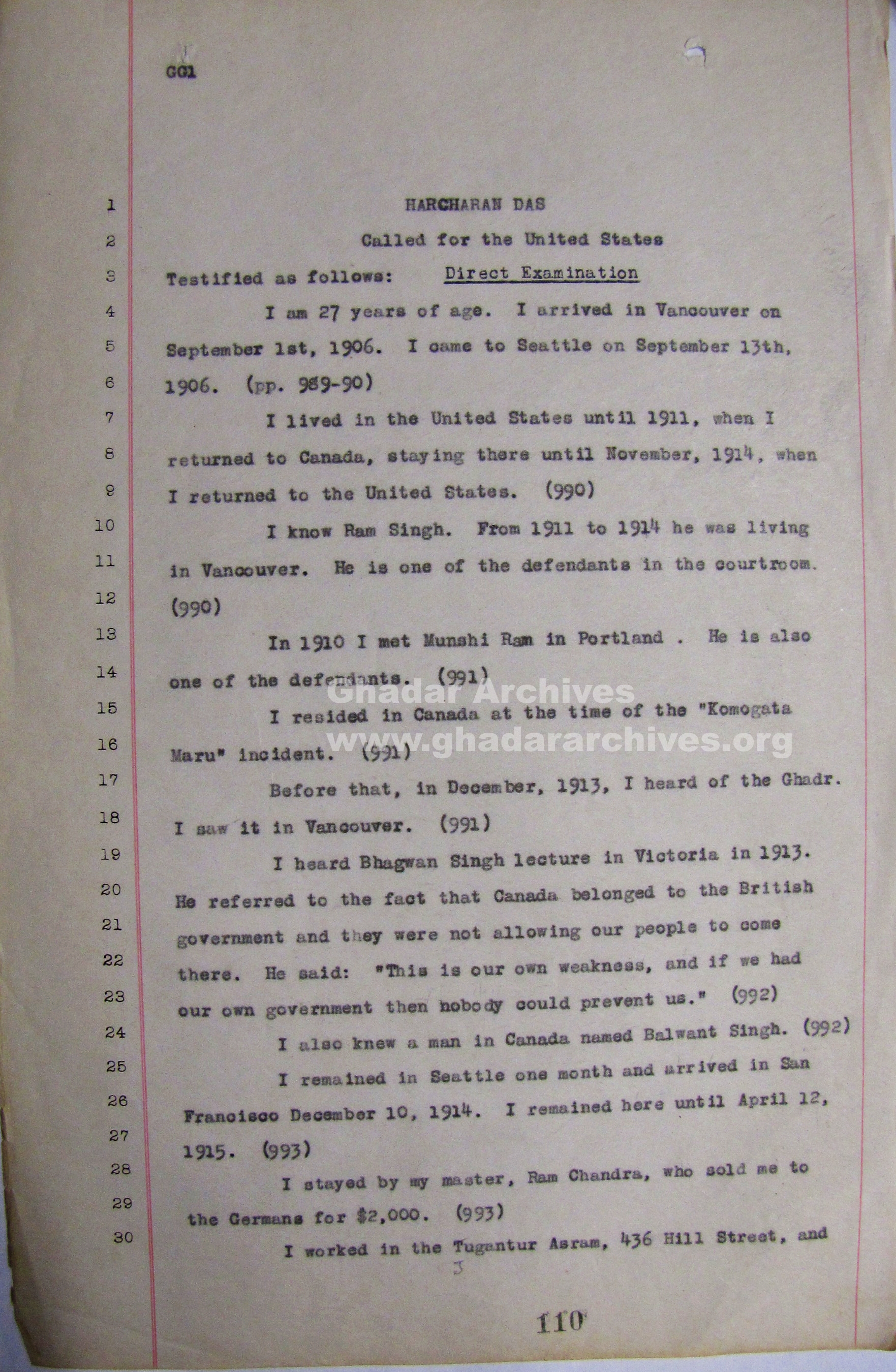
Harcharan Das - British Spy
Harcharan Das was one of the five Indians who were sent by Ram Chandra on 12 April 1915 to take arms and ammunition on board the steamship Maverick under the leadership of Hari Singh Osman. The mission failed because the ship Annie Larsen carrying the arms could not meet the Maverick and the five passengers on board were arrested by the British interceptors on the seas.
It was later discovered that Harcharan Das was a British spy who had sneaked his way into the very heart of the Gadar Party revolutionaries and he was a pet of Ram Chandra. Following incident is a proof of this:
For further substantiation of this charge other factors are: Firstly, Harcharan Das remained free in India and did not complain in the court like Jodh Singh and Shiv Dayal Kapur, etc. that he was confined in a solitary cell and whether he would go free after the trial or be sent back to face the treason trial in India; secondly, he was one of those who was kept in a hotel in America; thirdly, he admitted in the cross examination by the defense counsel Roche that "witness's father and brother hold government positions in India and that other members of his family are fighting in the English army"; and lastly, he produced in the court "blackened bits of revolutionary pamphlets" burnt in the engine of the Maverick.2
Harcharan Das arrived in Vancouver in 1905 and then went to the US the same year, remained five years there, and then returned to Canada. He knew Ram Singh and Balwant Singh Granthi. He was there when Bhagwan Singh was turned out from Victoria and the Komagata-maru arrived in Vancouver.
He returned to the US on 10 December 1914 and remain-ed there till 12 April 1915 when he was sent to India in a group of five. In this period, he joined the Gadar paper staff and worked in the Gadar printing press, living the same life in the Yugantar Ashram as others did. He came to know at close quarters the inner working of the Gadar revolutionaries working for India's freedom.
Harcharan Das's evidence showed mainly the activities of Ram Chandra. He was very much in the confidence of Ram Chandra who, according to the witness, told him many secrets of the Gadar Party. Giving details regarding the Gadar staff and the working of the paper, Harcharan Das said: "Ram Chandra was editor and head of everything." His main target was Ram Chandra.
Harcharan Das charged Ram Chandra of having a private fund, getting money from Germans and of embezzlement of funds; he charged that he was sold out by the latter to the Germans for $1,000, Ram Chandra repudiated these charges vehemently and called him a "well-trained professional witness." "I shall prove", said Ram Chandra, "that the British government has been coaching witnesses to cast gratuitous and utterly false aspersions at me during their testimony. This has been done so that the American public may withhold from us the sympathy which an American naturally and rightly feels for those who are struggling for human rights and liberties and vindicating their innocence against tremendous odds, "3
Harcharan Das told the court that "Ram Chandra kept two separate funds, the ashram fund for the Gadar itself and his own national fund which was seen only by Ram Chandra himself and Godha Ram. Mangu Ram said that there was $40,000 in the national fund. Sundar Singh, Godha Ram, Gopal Singh, G. B. Lal and witness were all present when Ram Chandra showed anger on receipt of a letter from Manila about Bhagwan Singh's conduct there."4
Continuing his evidence Harcharan Das said: He printed leaflets published by the Gadar which were to be sent to Germany and dropped from aeroplanes to the Indian troops in France. He further said: Von Brincken came from German consul and took away a bundle of these leaflets. Ram Chandra and Naranjan Das were present then. Ram Chandra often communicated with the German consul and said that he got all the money he wanted from the Germans. 5
Condemning the testimony of Harcharan Das, Ram Chandra said: "Harcharan Das has testified at Lahore and as a result of his testimony seven Hindus were hanged and more than twenty imprisoned for life. He also testified in Burma, the result being that five were hanged and more than twenty given life sentences. This man is willing to testify anything his British masters require."6
Book Title: Hindustan Ghadar Party - A Short History Vol -II (Pages 66-68)References
- Bulletin, Wednesday, 2 January 1918.
- Bulletin, Tuesday, 18 December 1917.
- Bulletin of Thursday, 20 December 1917; Examiner of the same date. For his evidence see 'Alphabetical Index', pp 18-21, Record No 118, The National Archives, FARC, San Bruno.
- Original Records, pp 1010-15.
- Original Records, pp 1019-21.
- Bulletin, Thursday, 20 December 1917.